A Complete Beginner-to-Advanced Guide to Building a Career in Artificial Intelligence
Artificial Intelligence (AI) is transforming how we work, learn, and solve real-world problems. From intelligent chatbots and recommendation systems to AI-powered automation and autonomous agents, AI is creating exciting opportunities for students, developers, and technology professionals.
But one important question remains:
How do you become an AI Engineer in 2026?
With so many programming languages, AI frameworks, machine learning techniques, and development tools available, beginners often struggle to decide where to start.
The good news is that you don't need to learn everything at once. Becoming an AI Engineer is a journey that begins with strong fundamentals and progresses toward advanced technologies.
At Study Networks, we believe in learning step by step, developing practical skills, and understanding how AI systems work rather than simply depending on AI tools.
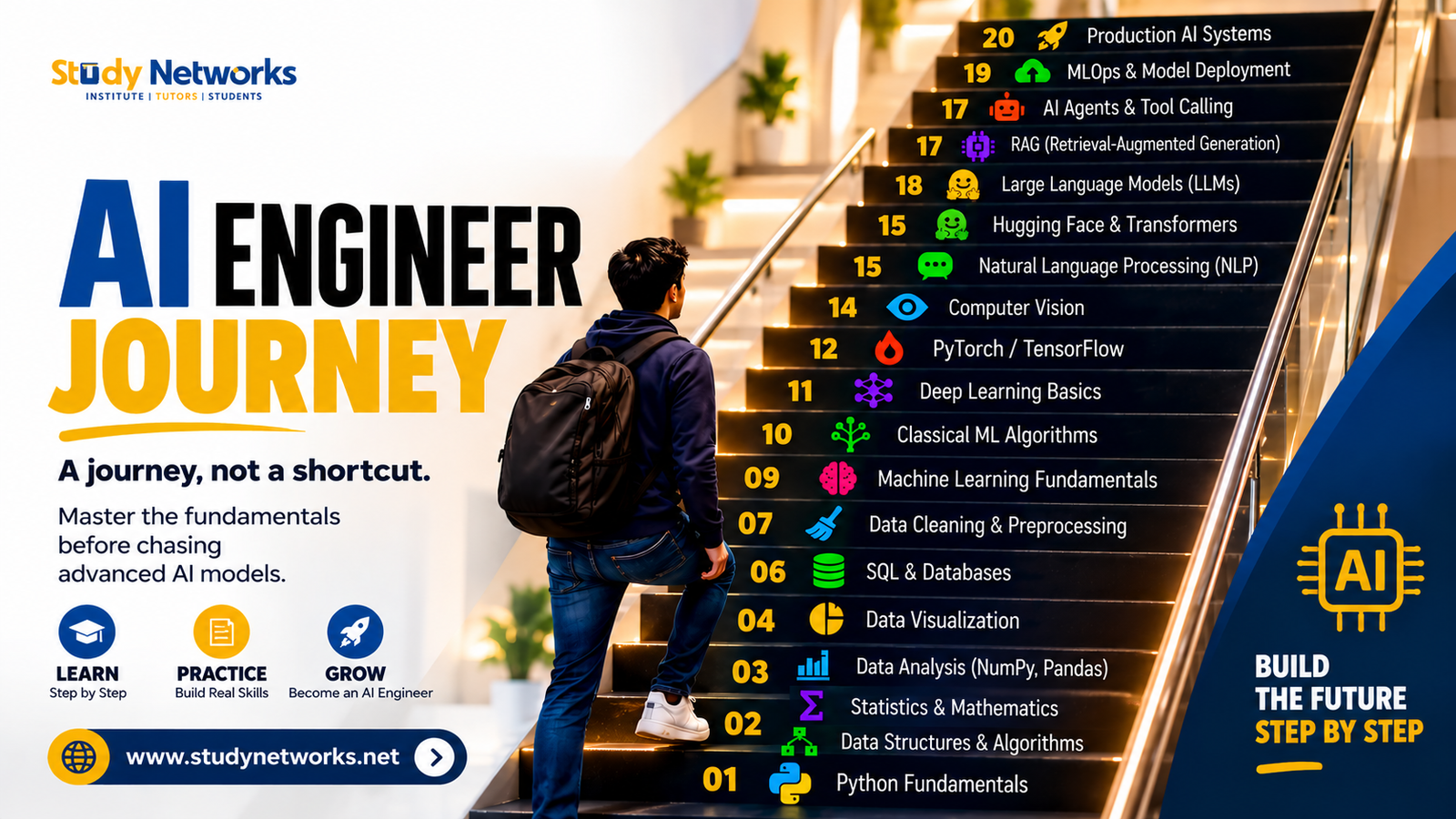
This guide presents a structured 20-step AI Engineer Roadmap for 2026, helping you understand what to learn, why each skill matters, and how to build practical experience.
What Is an AI Engineer?
An AI Engineer is a technology professional who designs, develops, integrates, and deploys intelligent systems using artificial intelligence, machine learning, deep learning, and modern software engineering practices.
AI Engineers work on applications such as:
- AI-powered chatbots and virtual assistants
- Machine learning prediction systems
- Computer vision and image recognition
- Natural Language Processing (NLP)
- Large Language Model (LLM) applications
- Retrieval-Augmented Generation (RAG) systems
- AI agents and workflow automation
- Production AI applications and intelligent business solutions
Becoming an AI Engineer requires more than knowing how to write prompts or use popular AI platforms. It requires a strong understanding of programming, data, mathematics, machine learning, and deployment technologies.
Complete AI Engineer Roadmap 2026
Phase 1: Build Strong Programming and Data Foundations
Step 1: Python Fundamentals
Python is one of the most widely used programming languages in artificial intelligence.
Start by learning variables, data types, loops, conditional statements, functions, object-oriented programming, and file handling.
Practice: Build a calculator, a basic automation script, or a simple data-processing application.
Step 2: Data Structures and Algorithms
Understanding data structures and algorithms helps you write efficient programs and solve technical problems.
Focus on arrays, lists, dictionaries, stacks, queues, trees, searching, sorting, and basic algorithm complexity.
Practice: Solve Python coding problems and build small applications using different data structures.
Step 3: Statistics and Mathematics
Mathematics helps you understand how AI models learn, predict, and make decisions.
Important topics include linear algebra, probability, statistics, calculus fundamentals, vectors, matrices, and optimization.
Practice: Calculate statistical measures and explore simple mathematical models using Python.
Step 4: Data Analysis with NumPy and Pandas
AI systems depend on data. Learning how to manipulate and analyze datasets is an essential skill.
Use NumPy for numerical computations and Pandas for working with structured datasets.
Practice: Analyze a sales dataset, student performance records, or public datasets.
Step 5: Data Visualization
Visualization makes complex information easier to understand.
Learn Matplotlib, Seaborn, and Plotly to create charts, identify patterns, and communicate insights.
Practice: Create a dashboard showing trends and comparisons in a real dataset.
Step 6: SQL and Databases
AI applications often interact with databases to retrieve, organize, and store information.
Learn SQL queries, joins, filtering, aggregation, and database design. Explore PostgreSQL or MySQL.
Practice: Build a small database and connect it with a Python application.
Step 7: Data Cleaning and Preprocessing
Real-world datasets often contain missing values, inconsistent formats, duplicate entries, and incorrect records.
Learn data cleaning, encoding, normalization, scaling, feature engineering, and dataset splitting.
Practice: Prepare a raw dataset for machine learning.
Phase 2: Learn Machine Learning and Deep Learning
Step 8: Machine Learning Fundamentals
Machine Learning enables computer systems to identify patterns and make predictions using data.
Understand supervised learning, unsupervised learning, model training, validation, overfitting, underfitting, and evaluation metrics.
Practice: Train your first predictive model using Scikit-learn.
Step 9: Classical Machine Learning Algorithms
Study widely used machine learning algorithms, including:
- Linear and logistic regression
- Decision trees
- Random forests
- Support Vector Machines
- K-Means clustering
- K-Nearest Neighbors
Practice: Build a house price prediction model or customer classification system.
Step 10: Deep Learning Basics
Deep learning uses artificial neural networks to learn complex representations from data.
Learn neurons, activation functions, neural network layers, backpropagation, gradient descent, and loss functions.
Practice: Build a neural network for handwritten digit recognition.
Step 11: PyTorch or TensorFlow
These frameworks help developers build, train, and evaluate deep learning models.
Begin with one framework before exploring the other.
Practice: Develop an image classification model using PyTorch or TensorFlow.
Phase 3: Explore Specialized AI Technologies
Step 12: Computer Vision
Computer Vision enables AI systems to interpret images and video.
Learn image preprocessing, convolutional neural networks, image classification, object detection, and segmentation.
Practice: Develop an object detection or image recognition application.
Step 13: Natural Language Processing (NLP)
NLP enables machines to process, analyze, and generate human language.
Study tokenization, text classification, embeddings, sentiment analysis, and language modeling.
Practice: Build a sentiment analysis application or text classifier.
Step 14: Hugging Face and Transformers
Transformers are fundamental to many modern language and multimodal AI systems.
Explore the Hugging Face ecosystem, pretrained models, tokenizers, inference pipelines, and fine-tuning techniques.
Practice: Use a pretrained transformer to build a text summarization or classification system.
Step 15: Large Language Models (LLMs)
Large Language Models are used in chatbots, content generation, document analysis, coding assistants, and many other applications.
Learn how LLMs work, prompting techniques, context windows, model inference, embeddings, and model evaluation.
Practice: Build an AI-powered question-answering application.
Step 16: Retrieval-Augmented Generation (RAG)
RAG combines information retrieval with language generation, allowing applications to answer questions using relevant external documents or knowledge sources.
Learn document chunking, embeddings, vector databases, retrieval, and response grounding.
Practice: Build a chatbot that answers questions from uploaded PDFs or company documents.
Step 17: AI Agents and Tool Calling
AI agents can use tools, interact with APIs, retrieve information, and execute multi-step workflows.
Study tool calling, API integration, state management, workflow orchestration, and safety controls.
Practice: Develop an AI assistant that retrieves information from a database and performs authorized tasks.
Phase 4: Learn AI Deployment and Production Systems
Step 18: MLOps and Model Deployment
Building an AI model is only part of the process. AI Engineers must also know how to deploy, monitor, and maintain applications.
Learn FastAPI, Docker, Git, model versioning, testing, cloud fundamentals, monitoring, and CI/CD.
Practice: Deploy a trained machine learning model as an API.
Step 19: Production AI Systems
Production AI involves developing reliable systems that work with real users and real-world requirements.
Focus on scalability, security, privacy, logging, error handling, evaluation, cost optimization, and system monitoring.
Practice: Turn an AI prototype into a tested application with an interface, API, and monitoring.
Step 20: Build Real-World AI Projects
The final step is applying your knowledge to practical problems.
Consider building:
- An AI customer support assistant
- An intelligent document analysis system
- An automated business workflow
- An AI-powered recommendation engine
- A computer vision application
- A secure RAG-based knowledge assistant
Publish your projects on GitHub, document your work, and develop a portfolio demonstrating your technical capabilities.
How Long Does It Take to Become an AI Engineer?
The learning timeline depends on your background, consistency, and practical experience.
Here is an illustrative 12-month learning plan for someone who can study and practice regularly.
DurationLearning FocusMonths 1–2Python, data structures, mathematicsMonths 3–4NumPy, Pandas, SQL, data visualization, preprocessingMonths 5–6Machine learning and classical algorithmsMonths 7–8Deep learning, PyTorch, computer vision, NLPMonths 9–10Transformers, LLMs, RAG, AI agentsMonths 11–12MLOps, deployment, production systems, portfolio projectsThis roadmap is flexible. Beginners may require additional time, particularly for mathematics, programming, and practical software engineering.
Best Learning Resources for Aspiring AI Engineers
Here are useful resources to support your AI learning journey:
- Python: https://docs.python.org/3/tutorial/
- NumPy: https://numpy.org/learn/
- Pandas: https://pandas.pydata.org/docs/
- Scikit-learn: https://scikit-learn.org/stable/
- PyTorch: https://pytorch.org/tutorials/
- TensorFlow: https://www.tensorflow.org/learn
- Hugging Face: https://huggingface.co/learn
- FastAPI: https://fastapi.tiangolo.com/
- Docker: https://docs.docker.com/get-started/
These resources can help learners build practical knowledge alongside structured courses and project work.
Common Mistakes to Avoid While Learning AI
Many beginners focus immediately on advanced AI tools without understanding programming or machine learning fundamentals.
Avoid these common mistakes:
- Jumping into LLMs without learning Python.
- Watching tutorials without implementing projects.
- Ignoring mathematics and statistics.
- Learning too many frameworks simultaneously.
- Copying code without understanding its behavior.
- Focusing only on model development while ignoring deployment.
- Building projects without testing, evaluation, or documentation.
A successful learning journey depends on consistent practice and a clear understanding of each stage.
Why Follow a Structured AI Learning Roadmap?
A structured learning roadmap helps students avoid confusion, maintain consistency, and gradually develop industry-relevant skills.
Instead of exploring random tutorials, learners can move systematically from Python programming to machine learning, deep learning, and advanced AI application development.
The goal is not simply to complete 20 topics. It is to understand the concepts, apply the skills, and build solutions that solve meaningful problems.
Start Your AI Engineering Journey with Study Networks
A journey, not a shortcut.
Artificial Intelligence offers exciting opportunities, but building a meaningful career requires patience, dedication, and practical experience.
Start with Python. Strengthen your mathematical foundation. Learn to work with data. Understand machine learning and deep learning. Explore advanced AI technologies. Finally, apply everything by building and deploying real-world AI systems.
At Study Networks, we encourage students and aspiring professionals to learn step by step, practice consistently, and develop skills for the future.
Learn. Practice. Grow.
Your AI engineering journey begins with your first step.
Explore more educational resources at: